Forward-looking commentary for a general audience, not personalised advice. The dollar split below is an illustrative mapping from BNP Paribas Equity Research (August 2026), redrawn by TraderMagz Research. It is a teaching frame for where hyperscaler build-out money lands in the supply chain, not a forecast of any company's revenue mix. Horizon: 2 to 5 years. Related house notes: The Wafer Makers, Memory Basket, AI Power & Nuclear.
Everyone owns "AI spend" through the same few megacap names. That is fine for a beta trade. It is a blunt instrument for a supply-chain trade. When a hyperscaler commits another ten billion dollars of capital expenditure (CapEx, money spent on long-lived assets rather than day-to-day costs), that money does not all buy graphics processors. A useful way to see the stack is to take an illustrative $100 of AI CapEx and ask where each dollar actually settles.
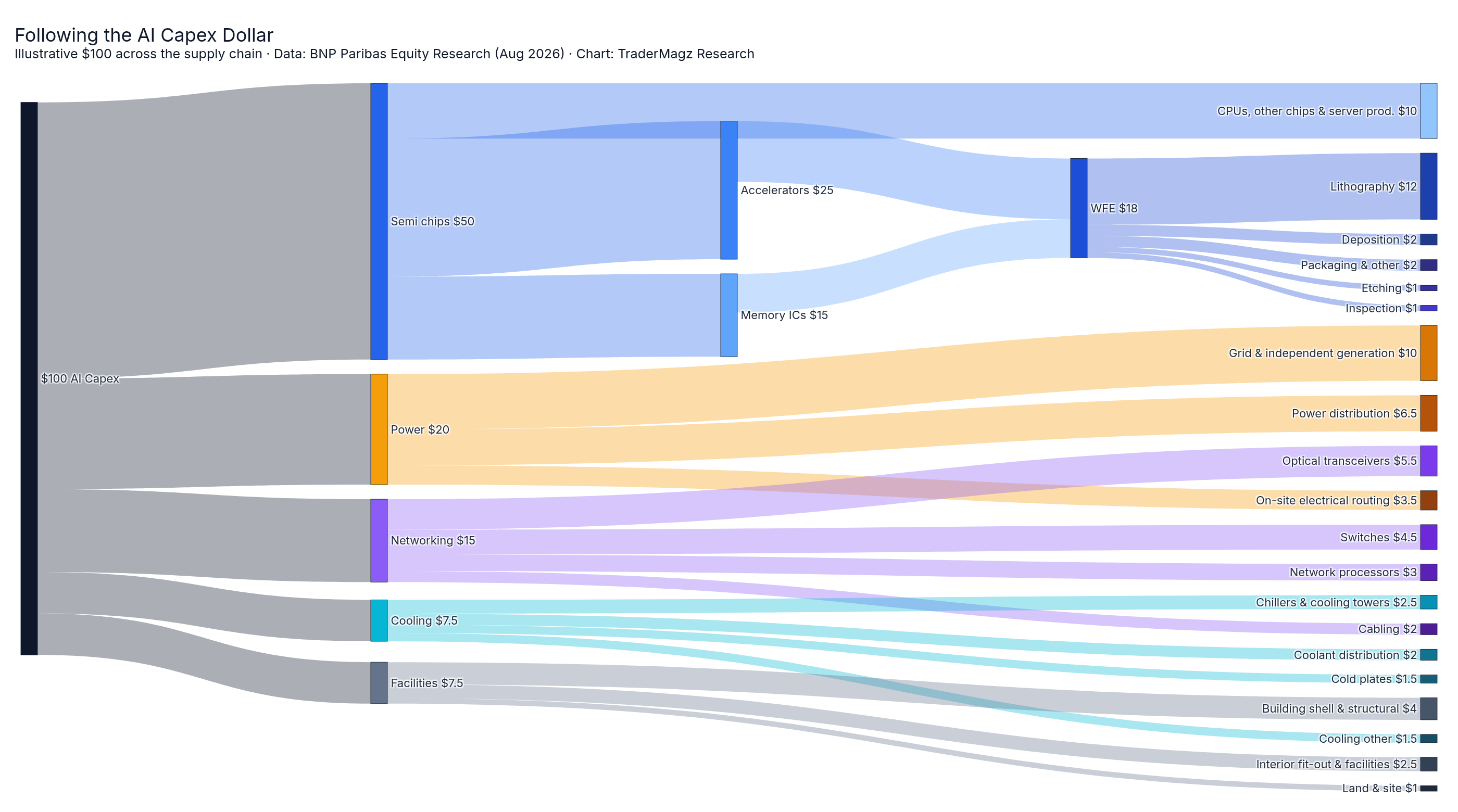
Source for the split: BNP Paribas Equity Research, August 2026 (illustrative $100 across the AI CapEx supply chain). Chart redrawn by TraderMagz Research. SankeyMATIC was used in the original public graphic; we rebuilt the flows for this note.
The tension
The market prices the AI build-out as a semiconductor story first, and everything else as a side quest. The illustrative map says semiconductors are about half the dollar. Power, networking, cooling, and facilities together are the other half. Inside that other half, power alone is $20, networking $15, and cooling plus facilities another $15. Put differently: more than a third of the illustrative dollar never buys a chip at all. It buys megawatts, racks of optics, cold plates, and concrete.
That matters because equity narratives travel at different speeds. Chip scarcity shows up in earnings within a quarter or two. Grid interconnect, transformer lead times, and liquid-cooling retrofit cycles show up as multi-year project calendars. If you only own the accelerator complex, you own the loudest half of the dollar. You do not own the half that becomes the binding constraint when the GPUs are available but the building cannot be powered or cooled.
How the $100 breaks
On the BNP Paribas Equity Research frame, the first cut is simple:
Semiconductors then split again. Accelerators (the AI training and inference chips that dominate headlines) take $25. Memory integrated circuits take $15. CPUs, other chips, and server production take $10. Nested inside the chip spend sits wafer fabrication equipment (WFE), the machines that print and process silicon: about $18 of the illustrative dollar, with lithography (the step that patterns circuits onto wafers, dominated in leading-edge EUV by ASML) alone at $12. Deposition, packaging, etching, and inspection make up the rest of that WFE slice.
Power is not "the utility bill." In CapEx terms it is grid connection and independent generation ($10), power distribution kit ($6.5), and on-site electrical routing ($3.5). Networking is optical transceivers ($5.5), switches ($4.5), network processors ($3), and cabling ($2). Cooling is chillers and towers, coolant distribution units, cold plates, and related gear. Facilities are the building shell, fit-out, and land.
None of these percentages are a valuation model. They are a map. Maps are useful when the market treats every AI ticker as a proxy for the whole territory.
What each sleeve actually sells
Accelerators and the GPU complex. Nvidia (NVDA) is the reference brand for the training and inference silicon that takes the largest chip slice. Peers and custom silicon programs (AMD, Broadcom's ASIC work, hyperscaler in-house designs) compete for share of that $25, but the economic point for this note is scarcity of leading-edge capacity and packaging, not a horse race among logos. When the map says half of CapEx is chips, this is the loudest quarter of that half.
Memory. High-bandwidth memory (HBM) and related DRAM sit in the $15 memory-IC bucket. Micron (MU) is the clean US-listed expression; SK Hynix and Samsung dominate the HBM mix offshore. Memory is cyclical even when AI demand is real. A map that puts memory at 15% of CapEx explains why memory stocks can look like AI beta and still trade like a cycle when pricing or China capacity narratives turn (see our memory basket note).
WFE and lithography. The $18 WFE nest, and especially $12 of lithography, is why ASML (ASML) keeps showing up in every serious AI-infrastructure conversation. You cannot print the next node without the tool. Lam, Applied, and KLA sit in etch, deposition, and inspection. Our wafer-makers note is the place for multiples and reverse-DCF detail; here the only claim is structural: a large minority of every chip dollar is equipment content before a finished accelerator ever ships.
Power. Eaton (ETN) and peers in electrical equipment, plus grid and generation names, map to the $20 power sleeve. Vertiv (VRT) straddles power and thermal infrastructure for data centers. Firm megawatts (including nuclear PPAs discussed in our AI power note) are a different security from a liquid-cooling skid, but CapEx buyers write cheques for both when a campus cannot light up.
Networking. Arista (ANET), Broadcom's networking franchise, and the optical/transceiver complex map to the $15 networking sleeve. As cluster sizes grow, the dollar share of optics and switching rises even when the GPU bill looks flat. Cabling is small in the map and still a project-critical path item.
Cooling and facilities. The combined $15 in cooling and buildings is the least glamorous and often the most delayed. Cold plates and coolant distribution are the liquid-cooling transition. Chillers, towers, shell, and fit-out are civil and mechanical schedules measured in quarters and years, not product cycles.
The insight a screener will not give you
A screener sorts by "AI exposure" and lands you in semiconductors. The CapEx map says the second-order trade is correlation of bottlenecks, not correlation of tickers.
When accelerators are scarce, Nvidia and the foundry stack earn scarcity rents. When accelerators are available but interconnect or power is not, the rent migrates. The illustrative $20 power and $7.5 cooling slices are small next to chips, yet they can gate the entire $50 chip program. That is why hyperscaler commentary increasingly spends more time on megawatts and cooling than on whether another GPU SKU exists.
A second insight sits inside the chip half. Lithography at $12 of every $100 is an enormous claim for a single process step. It is also why WFE can stay full even in a year when end-demand narratives wobble: the install base and the node transitions keep pulling tools. Memory at $15 is the opposite personality: huge AI pull, still a pricing cycle.
A third insight is about what the map is not. It does not say Nvidia is 25% of every hyperscaler's CapEx line. Hyperscalers also capitalise software, land banking, and long-lead generation assets differently. Treat the $100 as a physical build-out anatomy, then overlay each company's disclosure rather than the other way round.
What seems priced in, and the steelmanned bear
Base case for the next two to five years: AI CapEx stays elevated in absolute dollars, the mix keeps tilting toward power, cooling, and networking as cluster density rises, and semiconductor content remains the largest single sleeve even if its share of the narrative cools. Bottlenecks rotate; the total cheque does not vanish.
The bull case for owning the physical third (power, cooling, facilities, networking) is that GPU supply catches up before grid and thermal capacity does, so incremental CapEx dollars migrate along the map even if total CapEx growth slows. The bull case for staying overweight the chip half is that model scale and inference deployment keep accelerator and HBM intensity rising faster than the rest of the bill of materials.
The steelmanned bear is straightforward. CapEx guidance can roll over for reasons that have nothing to do with whether AI "works": higher cost of capital, weaker advertising or cloud growth, antitrust, or a simple digestion year after a surge of tool and GPU orders. In that world the map still describes where dollars went, but the level of dollars falls, and cyclical sleeves (memory, some WFE, discretionary facilities) get hit first. A second bear path is custom silicon: if more of the accelerator dollar shifts in-house or to ASICs, the merchant GPU complex loses share of the $25 without the power and cooling dollars shrinking. A third is policy: export controls and China tool restrictions reshape who can buy the lithography and WFE content even when demand exists.
Thesis breaks if hyperscalers cut disclosed AI CapEx in a sustained way, if interconnect and power constraints ease so fast that scarcity rents leave the physical third, or if memory and WFE roll into a classic downcycle while the GPU narrative is still being sold as immortal.
How we rank the sleeves (not a trade ticket)
Criterion: which bottleneck stays scarce longest if CapEx stays high but decelerates, inside a two-to-five-year window.
- Leading-edge lithography / WFE choke points (ASML and the tool stack). Hard to substitute, long lead times, nested inside every advanced chip dollar.
- Power delivery and data-center electrical / thermal infrastructure (ETN, VRT, and firm-power operators where contracts are real). Gates the whole campus.
- Accelerators (NVDA as the reference). Highest dollar share, also the most owned narrative; scarcity is real, ownership is crowded.
- Networking / optics (ANET and peers). Rises with cluster scale; less of a single choke point than lithography or megawatts.
- Memory (MU and the HBM complex). Essential, high dollar share, still a cycle. Size it like a cycle with an AI overlay, not like a monopoly utility.
- Facilities shell and land. Necessary, usually the least differentiated equity expression.
This ranking is about bottleneck durability, not about which stock will outperform next quarter. Crowding can invert near-term returns even when the map is right.
What we are watching next
Hyperscaler CapEx guides and the mix commentary on power versus compute. Lead times and backlog commentary from electrical equipment, cooling, and optical suppliers. WFE and lithography order commentary versus memory pricing. Interconnect and substation queues in the big US data-center markets. Any shift in the accelerator mix toward custom silicon that changes who captures the $25. Updates to our related notes on wafers, memory, and nuclear/firm power.
Bottom line
An illustrative $100 of AI CapEx is not a GPU purchase order with loose change. About $50 is semiconductors, $20 is power, $15 is networking, and $15 is cooling and buildings, with lithography alone claiming $12 inside the chip half (BNP Paribas Equity Research, Aug 2026, illustrative). The investable mistake is treating "AI CapEx" as one trade. Own the loudest half if you want the beta. Respect the quieter third if you care which bottleneck still bites after the GPU headline cools. This is research, not personal advice.
Primary sources
- BNP Paribas Equity Research, illustrative AI CapEx supply-chain allocation (August 2026); public Sankey graphic credited to BNP Paribas Equity Research / SankeyMATIC
- TraderMagz Research house notes: semicap & foundry stack (28 Sep 2026), memory basket, AI power & nuclear (7 Sep 2026, updated 17 Sep 2026)