Everyone agrees that stocks, funds and bonds are moving onchain. Fewer people ask who supplies the prices those tokens trade on at 3am on a Sunday, when Nasdaq is shut. Pyth Network is the quiet answer, and this year it started charging for it.
Our house view is to hold PYTH through the tokenization cycle and add on weakness rather than chase strength. The business is real and growing fast, the token now has a revenue-funded buyer, and Pyth owns the one corner of oracle land where it beats Chainlink. But most of the good news is already in the price, and a big unlock lands in May 2027. That argues for patience, not leverage.
The short version
- Pyth's annualised recurring revenue (ARR, the yearly value of current subscriptions) went from about $1M in December 2025 to $11.5M at the end of Q3 2026, with 276 paying clients.
- Since 8 October, 100% of the DAO's revenue share (about 60% of product revenue) buys PYTH every month: roughly $6.9M a year, about 1% of the float.
- PYTH is about 7% of Chainlink's market cap but trades on roughly a third of its revenue multiple, and is growing much faster. Chainlink is bigger, broader and safer.
- Our base case is $0.054 to $0.099 by end-2027, with a probability-weighted value of about $0.095. The bull case is $0.20 to $0.30.
- In a full crypto bull market, our top scenarios are $0.32, then $0.50 to $0.55, with the old $1.20 high as a stretch. These are scenarios built from stated assumptions, not forecasts.
- The risks: a 27% float increase on 19 May 2027, growth that slowed to 11% a month in September, a full valuation, Chainlink, and any crypto-wide drawdown.
Why tokenization needs Pyth
A tokenized Amazon share trading on Solana on a Sunday still needs a fair price, and the exchange that normally sets it is closed. Someone has to publish a 24/7 mark, and the venues building these markets have mostly picked Pyth.
The volume is already large. Real-world-asset perpetual futures (perps, leveraged contracts on stocks, commodities and FX that never expire) traded $751.9B in August, with Pyth pricing 96.3% of it (Pyth RWA report). September volume fell 15% to $637.85B, but open interest hit a record $12.61B and Pyth's share was 90.3% (Crypto Economy). Equities were 49% of that volume.
The pipes into traditional finance are being laid too. Nasdaq chose Pyth as its first onchain distributor of TotalView in June and approved it to distribute Nasdaq Basic on 22 September (Cointelegraph, KuCoin). Euronext, Tradeweb, SGX FX and the US Department of Commerce publish through Pyth's Data Marketplace, and Securitize launched 12 tokenized US stocks on Solana on 8 October. Every new tokenized stock is another asset that needs a price around the clock.
From free oracle to paid data business
For most of its life Pyth gave its data away. In 2026 it began selling four products: Pyth Pro (subscription market data across crypto, equities, FX, rates and commodities), Pyth Indices (24/7 indices for derivatives venues), the Data Marketplace (where exchanges like Nasdaq sell their own data through Pyth) and Pyth Core, the original oracle, which since 31 July needs an API key and a paid plan after a trial.
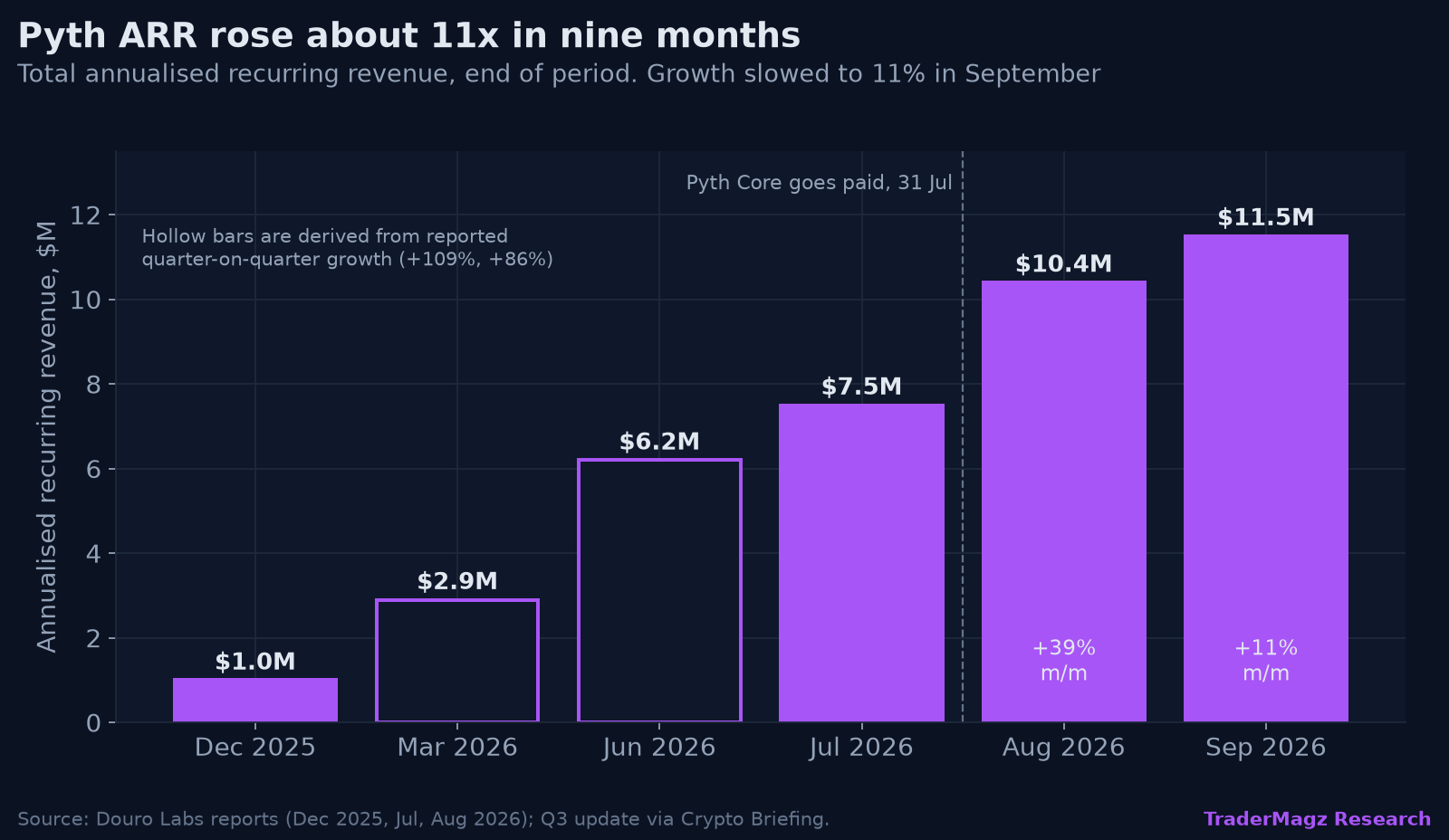
ARR rose about 11x in nine months, and paying accounts went from 107 in Q2 to 276 in Q3. The honest caveat is the slope: ARR jumped 39% in August when free Core users had to start paying, then grew 11% in September. We treat September as the cleaner read, and it is still fast.
This is why a holder can sit through the volatility. Under OP-PIP-136, approved on 8 October, every eligible DAO revenue dollar buys PYTH on the open market each month without a vote, and the tokens go into the PYTH Reserve, which can never sell them (Crypto Briefing). The buyback is small today but scales with revenue. At $50M of ARR the DAO would buy about $30M a year, roughly 3.6% of total supply at today's price, which is where supply dynamics start to turn.
Pyth vs Chainlink: the technology
Chainlink is the incumbent oracle (the system that feeds outside data into smart contracts), so it is the obvious comparison. They are less direct rivals than they look.
The core difference is push versus pull. Chainlink's classic Data Feeds push a price onchain whenever it moves past a deviation threshold or a set heartbeat passes (Chainlink docs). That gives lending protocols a reliable onchain record, but every update costs gas, so updates are spaced out. Pyth pulls: prices update off-chain every 400 milliseconds, and an app pulls the latest signed price onchain only when it needs it (Pyth docs). Pyth Pro streams on 1 to 50 millisecond channels. Chainlink's answer, Data Streams, is also pull-based with sub-second latency, so the speed gap has narrowed at the top end.
The second difference is who supplies the data. Pyth's 138+ publishers, including Jane Street, Cboe, Jump, Binance and OKX, publish their own prices directly. Chainlink's node operators mostly fetch and aggregate data from third-party providers. Pyth looks more like an exchange data feed, which is why licences like Nasdaq's sit naturally on top of it.
Sources: Pyth docs and blog; Chainlink docs and Q2 2026 review; KuCoin Square oracle comparison (July 2026).
Chainlink sells the rails of tokenization: cross-chain messaging, Proof of Reserve, compliance tooling, and links with DTCC and Swift. Pyth sells the prices. Chainlink is about 10x bigger in DeFi collateral, where Pyth has no real answer. Pyth is strongest where Chainlink is weakest, in fast, cross-asset prices for trading venues.
Pyth vs Chainlink: the price
On size there is no contest. On revenue multiples, PYTH screens cheaper.
Prices and supply from CoinGecko, 10:39 SAST. Chainlink revenue from DefiLlama.
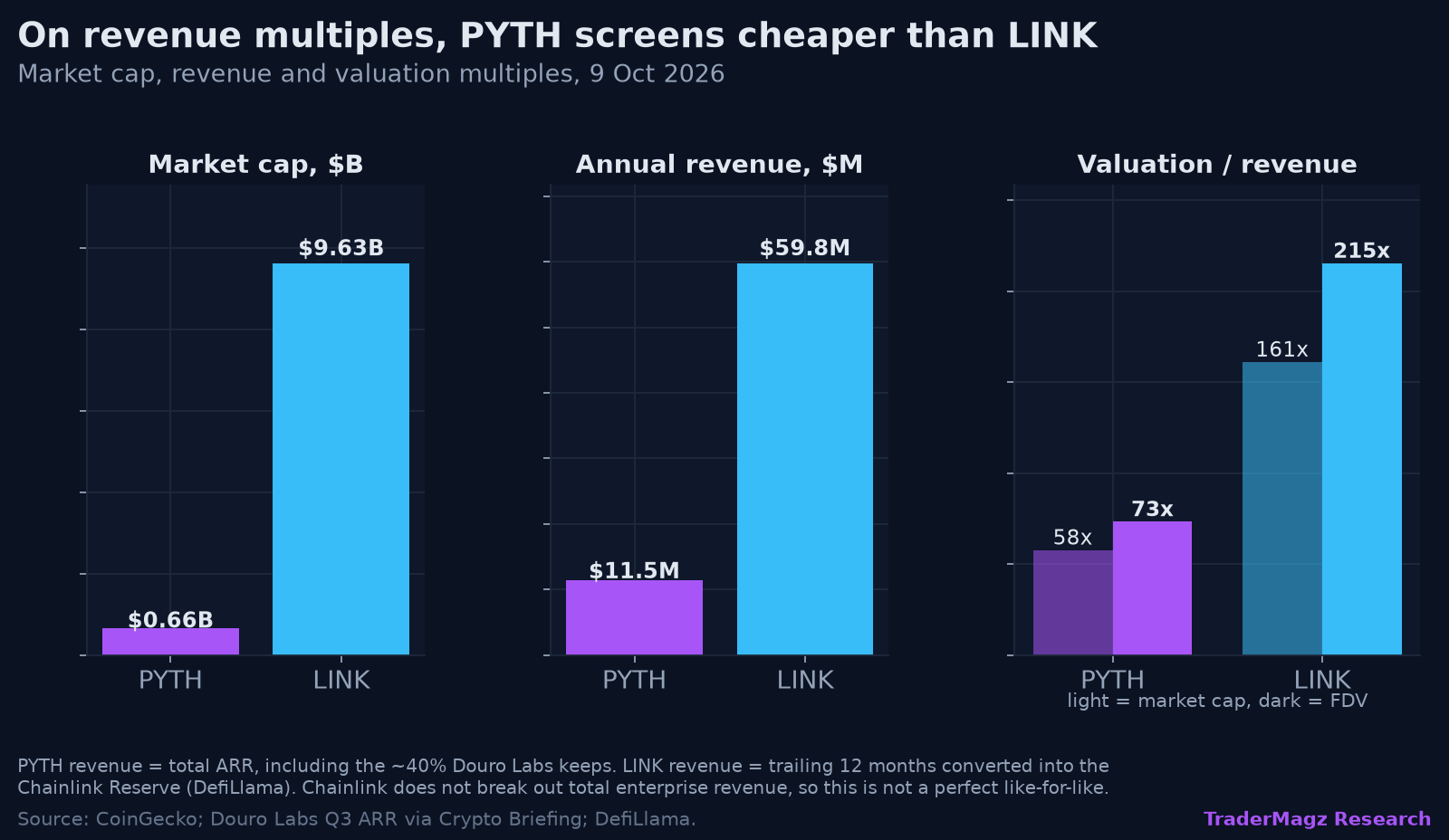
Two caveats. Pyth's ARR is gross, and Douro Labs, the private company that sells Pyth Pro, keeps about 40% before token holders see it, so on the DAO's share alone PYTH trades at about 122x FDV. Chainlink's figure is the revenue it converts into its LINK reserve. Chainlink says enterprises have paid it "hundreds of millions of dollars" over time but publishes no total revenue figure, so we cannot source one. What we can see is that its reserve revenue has been flat at about $15M a quarter for four quarters, while Pyth's has compounded.
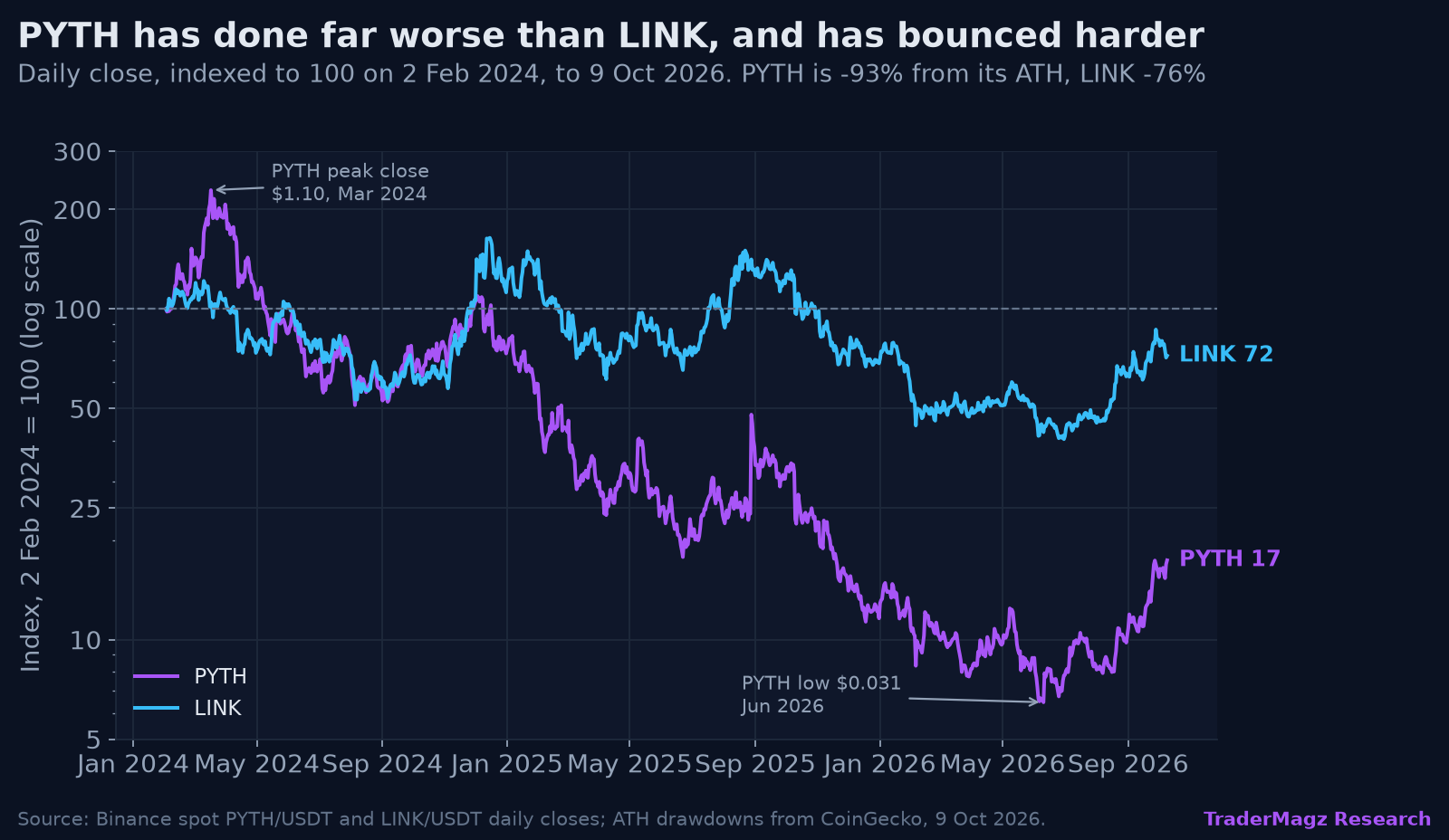
Price history is the other half. PYTH is down 83% from its first Binance close in February 2024, against 28% for LINK, and it hit an all-time low of $0.0295 in June 2026 (CoinGecko). It has nearly tripled since, including 54% in the last 30 days on the buyback news.
What the price already assumes
At an FDV of about $820M to $845M, the market is betting that ARR reaches roughly $40M to $55M within two to three years. If a maturing data network settles at 15x to 20x ARR, today's FDV needs $41M at 20x or $55M at 15x, 3.6x to 4.8x today's ARR.
That is a fair bet, not a heroic one. Compounding September's 10% to 11% monthly growth for 15 months reaches about $48M. At 6% a month it gets only about $28M. So the price assumes Pyth roughly holds its pace into 2027, with little room for a crypto bear market. That is why we hold rather than chase.
Base, bull and a bull-market top
Our end-2027 scenarios use the full 10B supply, because the last unlock lands in May 2027.
The probability-weighted value is about $0.095 (0.30 × $0.024 + 0.50 × $0.077 + 0.20 × $0.25), about 13% above today's price. The median outcome is close to where PYTH trades now. The upside lives in the bull tail, which is exactly why we hold rather than buy aggressively.
Crypto valuations do not stop at fair value in a bull market. They overshoot. So we mapped where a full bull-market top could take PYTH if tokenization becomes the cycle's main story. Each level comes from a stated assumption and uses about 10B tokens in circulation, which is where supply sits after the 19 May 2027 unlock (7.875B today plus 2.125B). Market cap and FDV are then effectively the same.
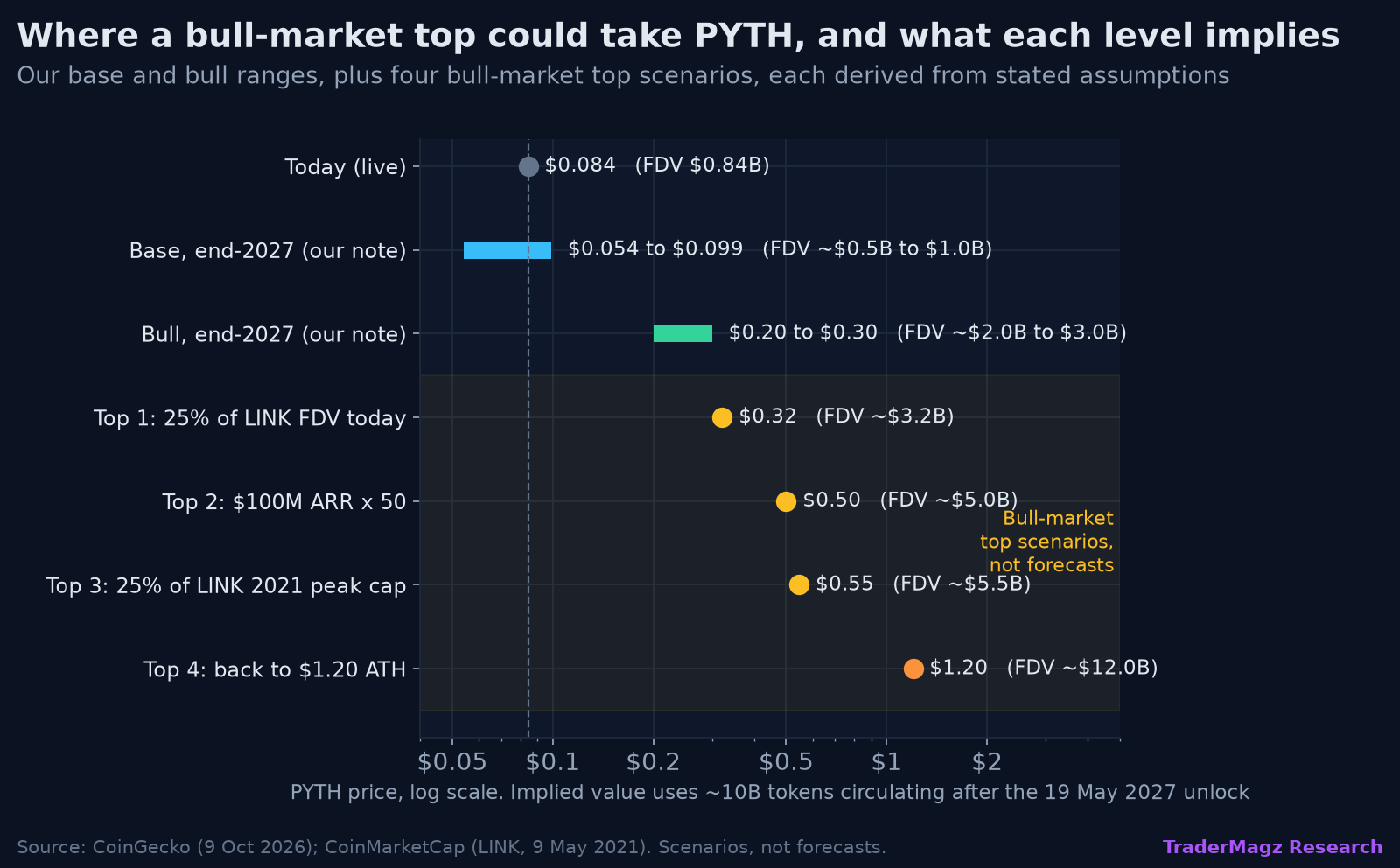
Two separate methods landing at $0.50 to $0.55 is the useful part. That is our main top zone, about 6x from here, and it only holds up if ARR is near $100M by then. The $1.20 level is the number people will quote, but in March 2024 that price meant about $1.8B of market cap with 1.5B tokens circulating (CoinMarketCap). On 10B tokens it is a $12B company.
The risks, steelmanned
The best bear argument is that the revenue spike was a one-time conversion of free users, and the token captures too little of it to outrun the 2027 supply.
The unlock is the big one. On 19 May 2027, 2.125B PYTH unlocks, 27% of today's float, and at today's run-rate buybacks of about 84M PYTH a year would take roughly 25 years to absorb it. Most of it (ecosystem growth, publisher rewards, protocol development) leaks out over time. Only the 250M private-sale tranche is classic investor supply, and past PYTH unlocks were followed by low volatility (Tokenomist). It is an overhang, not a single dump, but it caps how fast the price can run.
Growth is slowing. Strip out the paid migration and the organic pace may be 5% to 8% a month, and charging for Core invites churn to Chainlink or RedStone when free trials end. The valuation is already full: at 73x ARR, PYTH needs growth above roughly 80% a year to hold its multiple. And the token is a minority claim. Douro Labs keeps about 40% of revenue, and a proposal, CO-PIP-105, would let Douro pay the DAO in PYTH instead of cash, shrinking open-market buying.
Chainlink is the competitor that matters. It is about 10x bigger in DeFi value secured, owns the tokenization plumbing, and Data Streams now competes on speed. Pyth also had its own scare when Core went down for 4 to 5 hours in late May 2026.
And it is still crypto. PYTH is up 54% in 30 days with perp volume about 18x spot, and leverage-led rallies tend to retrace. A crypto-wide drawdown would hit a small token far harder than the business. Bitcoin is $82.6K, about 15% above its 200-day average, and the TMZ crypto desk reads Early Bull with a lean toward majors: supportive, but not a green light for alts.
What would make us stop holding
We hold while the revenue engine keeps working. We would stop holding, or downgrade to Avoid, on any of these:
- Q4 2026 ARR below about $13M, under 15% quarter-on-quarter growth. We want more than $15M.
- Two months of growth below 4%, or paying clients stuck near 276 after Core trials expire.
- Pyth's share of RWA perp volume falling below 75%, from 90.3%.
- DAO revenue paid in PYTH replacing open-market buybacks.
- A risk-off crypto regime, with Bitcoin losing its 200-day average.
There is also a good reason to sell: success at the wrong price. If PYTH reaches $0.50 to $0.55 while ARR is still well short of $100M, the multiple is doing the work, not the business, and we would take profits rather than hold out for $1.20.
Tactically, we would not chase this spike. Our accumulation zone is $0.065 to $0.072, the late-September base, with nothing added above $0.085. A daily close below about $0.057 invalidates the swing view, and swing targets are $0.10, then $0.12 if Q4 ARR beats $15M. The next checkpoints are the monthly Douro Labs reports, the Q4 update in early January, and the unlock on 19 May 2027.
Bottom line
Pyth is a rare crypto token with a real, fast-growing business under it, a revenue-funded buyer every month, and a role in tokenization that Chainlink does not fill. That is why we hold it through the cycle. But the base case says the price is roughly fair and the 2027 unlock is a known headwind, so we add on weakness and let the bull tail pay us. If tokenization becomes the story of this bull market, $0.50 to $0.55 is a defensible top zone. $1.20 needs Pyth to become worth what Chainlink is today.
Sources: CoinGecko (PYTH and LINK, 9 Oct 2026); Binance daily closes; CoinMarketCap historical data; Crypto Briefing (OP-PIP-136, Q3 ARR); Douro Labs and Pyth monthly reports; Pyth RWA perp report; Crypto Economy; Cointelegraph and KuCoin (Nasdaq); DefiLlama (PYTH unlocks, Chainlink revenue); Tokenomist; Pyth and Chainlink docs; Chainlink Reserve announcement and Q2 2026 review; KuCoin Square; Coin Alert News; TMZ terminal crypto desk.
This is general commentary, not personal financial advice. Crypto assets are volatile and you can lose your whole investment.