Privacy is the best-performing idea in crypto this year. Zcash is up about 340% in twelve months to a $21B market cap and has had a US spot ETF since August. Monero is worth $10B. Canton, the institutions' private ledger, is worth $4.8B. Midnight, the privacy chain built by the team behind Cardano, is worth $0.82B, and until last month it was worth less than $0.35B.
Our view is that Midnight has the most thoughtful design in the sector and a real chance to become the privacy layer that regulated apps can use. But NIGHT has nearly tripled since late August, its network is still run by a handful of approved operators, the token earns no fees, and half the supply sits with two Midnight entities. We would put it on the watchlist and buy pullbacks, not chase the breakout.
The short version
- Midnight lets an app prove something (you are over 18, you passed KYC, you have the collateral) without revealing the data behind it. Developers write these apps in Compact, a language based on TypeScript.
- It splits its token in two. NIGHT is public and tradeable. Holding it generates DUST, a private, non-transferable resource that pays for transactions and slowly decays. Fees are burned DUST, so no NIGHT holder earns fee revenue.
- Mainnet went live on 30 March 2026 with federated operators including Google Cloud, MoneyGram and Worldpay. Anyone could deploy smart contracts only from 28 September. Daily transactions jumped from 284 on 1 October to 26,178 on 8 October.
- At $0.049, NIGHT has a $0.82B market cap and a $1.18B fully diluted value (FDV). It is 58% below its December high and up 137% in 30 days.
- Our end-2027 base case is $0.046 to $0.069, with a probability-weighted value of about $0.068. The bull case is $0.15 to $0.20. Bull-market top scenarios sit at $0.11 to $0.12, then $0.28 to $0.30, with $0.57 as a stretch. These are scenarios built from stated assumptions, not forecasts.
- The risks: 50% of supply held by the Midnight Foundation and Midnight TGE Ltd, a usage spike that may be testing, a decentralisation timeline that has already slipped, no direct value capture, and a token that just went parabolic.
What Midnight does, in plain English
Most blockchains are glass boxes. Every balance, payment and contract call is public forever. That is fine for speculation and useless for payroll, medical records, bank trades or anything a company would not post on a billboard.
The old answer was privacy coins like Monero and Zcash, which hide who paid whom. They work, but they hide everything, so regulators treat them as a laundering risk, and Monero has been delisted by several major exchanges. Midnight's pitch is what it calls rational privacy: keep data private by default, but let the user or app prove specific facts to specific people when the rules require it.
It does this with zero-knowledge proofs, maths that lets you prove a statement is true without showing the inputs. A Midnight contract has a public part that anyone can read and a private part that only the people involved can see. The private computation runs on the user's own device, which sends the network a proof that the rules were followed rather than the data itself. A lender could check a borrower's collateral, or an exchange could confirm a customer passed KYC, without either piece of personal data ever touching the chain.
Midnight is a partner chain of Cardano. NIGHT exists natively on both networks, Cardano stake pool operators (SPOs) are meant to take over block production, and Cardano holders got 50% of the airdrop. Block time is about six seconds (Midnight FAQ).
NIGHT and DUST: the unusual token design
Midnight separates owning the network from using it.
- NIGHT is the asset. It is public, tradeable and listed on Binance, Kraken, OKX and Japanese exchanges. It will be used for block rewards and governance.
- DUST is the fuel. Every NIGHT you hold slowly fills a DUST battery, up to 5 DUST per NIGHT over about seven days (Midnight FAQ). DUST pays transaction fees, is shielded so spending it leaks no metadata, cannot be sent to anyone else, and decays if you sell the NIGHT that generated it.
This has three useful effects. Costs are predictable, because an app that holds enough NIGHT can transact without buying fuel at whatever price the token trades on that day. Apps can sponsor their users, who never need to touch a token, much like a website paying its own server bill. And it is easier to defend to a regulator: the tradeable asset is fully transparent, while the private resource cannot be transferred, so it cannot be used to move value.
The catch for investors is value capture. Fees are paid in DUST and burned. Nobody earns them, and no NIGHT is burned. NIGHT is worth owning only if apps and users need to hold it to generate DUST, if SPOs want it as block rewards, and if a DUST leasing market (the planned Capacity Exchange) lets holders rent out spare capacity. None of those demand sources is live at scale yet. Unlike Pyth, there is no revenue line to anchor a valuation.
Where the network stands
Mainnet launched on 30 March 2026 in a deliberately guarded first phase, Kūkolu, with up to 13 federated block producers. Named operators include Google Cloud, MoneyGram, Worldpay, Bullish, Vodafone's Pairpoint, eToro, AlphaTON Capital and Blockdaemon, and the Midnight Foundation runs two nodes itself (Midnight whitepaper, CryptoSlate). That is a strong roster for a privacy chain, and it is also, for now, a permissioned network.
The real switch-on was 28 September, when smart contract deployment became permissionless and contracts no longer needed a security review on the test network first. Daily transactions went from 284 on 1 October to 26,178 on 8 October (Midnight Explorer via TokenPost). That is a 92x jump in a week, but it is one week, right after the doors opened, and the reports do not show how much is developers testing. We want to see it hold through November.
What is still to come:
- v8, private smart contracts and custom private tokens on mainnet, targeted for Q4 2026. v9 adds contract-to-contract calls.
- Mōhalu, the phase where Cardano SPOs start producing blocks, block rewards begin and the DUST Capacity Exchange launches. It was pencilled in for Q2 to Q3 2026 and has no firm date.
- Hua, full decentralisation and Midnight privacy for apps on other chains.
The ecosystem around it is real but early. OpenZeppelin is building Midnight's contract library, Google Cloud runs a testnet faucet, and wallets are adding shielded balances and sponsored fees. There was one serious accident. On 20 to 21 July, an attacker drained 515M NIGHT (about $9M to $13M) from the third-party Wanchain bridge between Cardano and BNB Chain and dumped about 300M on decentralised exchanges, sending NIGHT down more than 30% (KuCoin, Cryptonomist). Midnight itself was not hit, but it shows how thin the token's liquidity was.
How Midnight compares
These networks are less direct rivals than the market caps suggest. They make different bets on what should be private and who gets to see it.
Sources: CoinGecko (11 Oct 2026, 10:00 UTC); project docs; DEV Community and Milk Road comparisons.
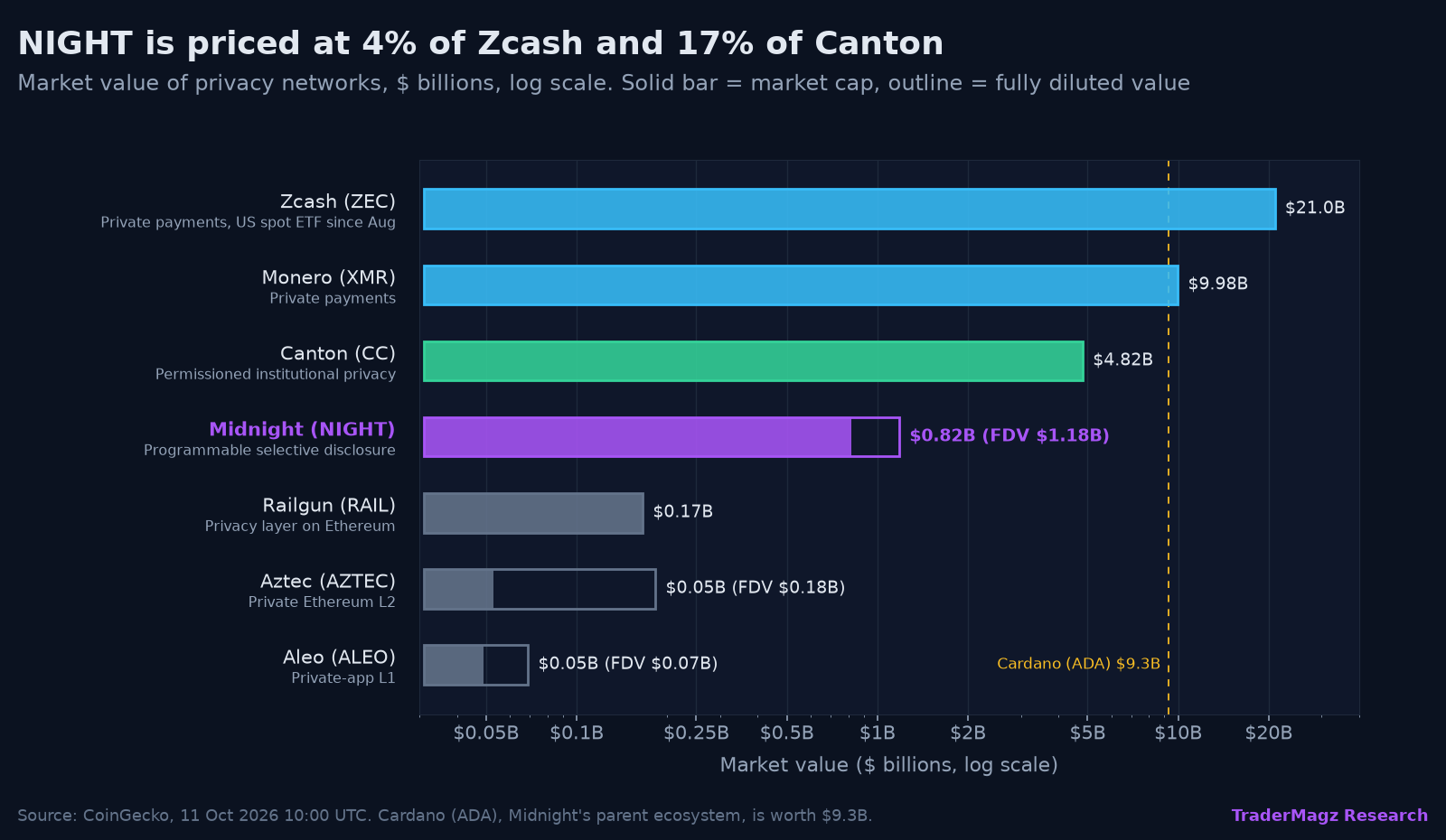
Zcash and Monero are money. They are the purest privacy bets and have the most liquidity, but you cannot build an app on them. Canton is the institutions' choice and already settles real tokenized assets, but it is not built for open public apps. Aztec and Aleo are Midnight's closest technical peers, and the market has given up on both, down 56% and 99.5% from their highs. That last point matters: being technically good at programmable privacy has not, so far, been enough to create value.
Midnight's edge is the combination: programmable privacy, a compliance-first design, a familiar language, institutional operators and a built-in community of Cardano holders. Its weakness is that it is the youngest and least proven of the group.
Tokenomics: where the 24B NIGHT sits
NIGHT has a fixed supply of 24B. There was no token sale and no venture allocation: the Glacier Drop let holders of ADA, BTC, ETH, SOL, XRP, BNB, AVAX and BAT claim NIGHT for free, and the Scavenger Mine let anyone earn the unclaimed tokens by running computations. More than 8 million addresses took part. That is a genuinely broad distribution. But claims took only about 19% of supply, and most of the leftover went to Midnight's own entities.
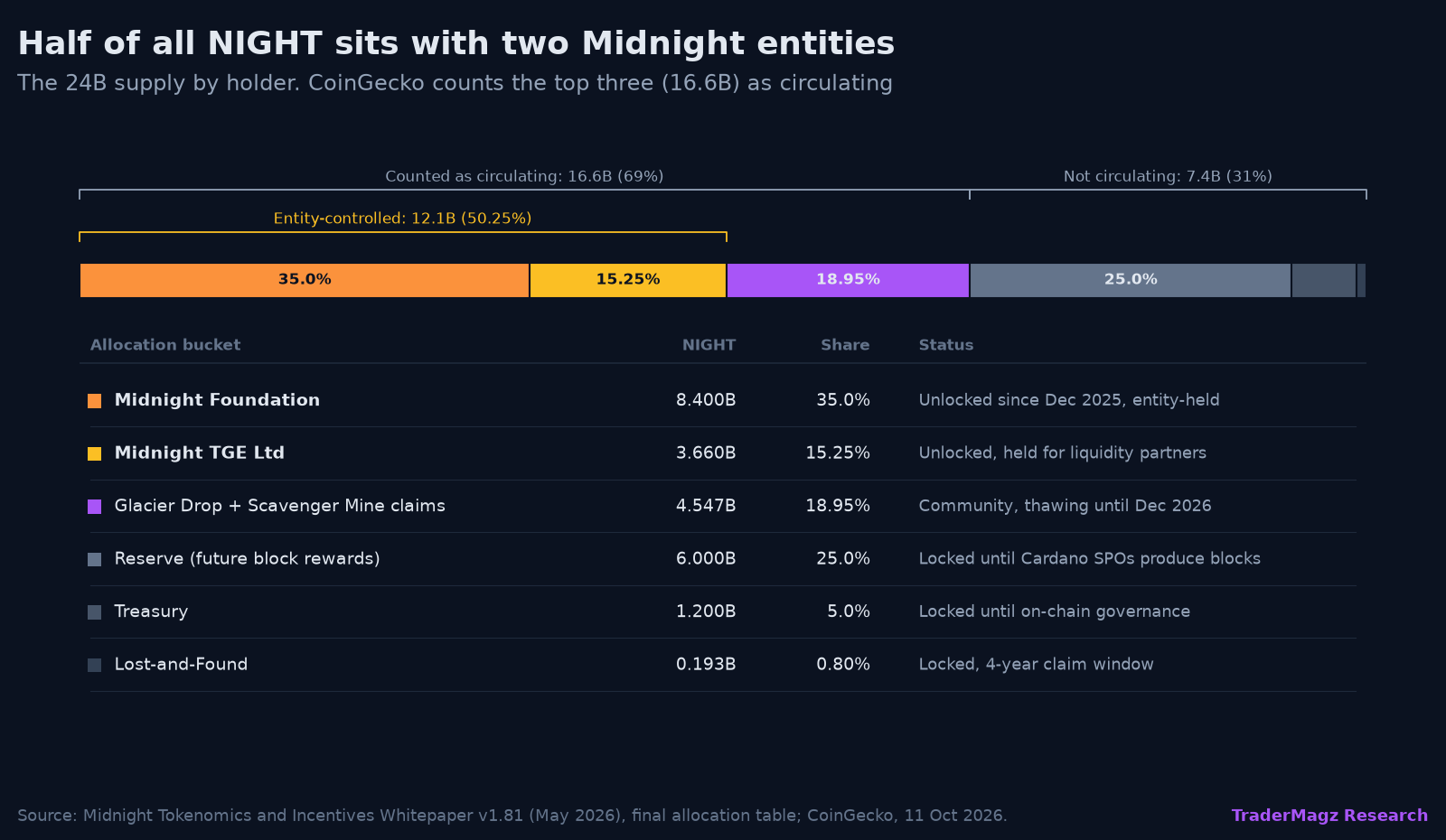
Source: Midnight Tokenomics and Incentives Whitepaper v1.81 (May 2026).
Three things follow.
First, the headline float overstates what trades. CoinGecko counts 16.6B NIGHT as circulating, but 12.06B of that sits with the Foundation and Midnight TGE Ltd. The whitepaper itself flags the concentration and warns that the Foundation may act against the interests of some holders. The public float is closer to 4.5B to 5B NIGHT, about $0.22B to $0.25B at today's price. That makes the token move hard both ways, as July and the last six weeks showed.
Second, the scheduled unlock risk is small and nearly over. The claims thaw near-linearly from December 2025 to December 2026, so roughly 0.6B to 0.7B NIGHT is still to unlock over the next eight weeks. The real overhang is discretionary: what the two entities do with 12B tokens. The TGE pool exists to fund exchange and liquidity partnerships, so some of it is meant to reach the market.
Third, new issuance is slow. Block rewards come only from the 6B Reserve, as a fixed share of what is left each block, so emissions start below Ethereum's and Cardano's original rates and shrink over time. They only begin when SPOs produce blocks.
What the price already assumes
There is no revenue to value, so the honest tools are comparisons. At $0.82B, NIGHT is valued at 3.9% of Zcash, 8% of Monero, 17% of Canton and 8.8% of Cardano, its parent ecosystem.
Before September, the market priced Midnight like Aztec and Aleo: a good idea with no proof of use, worth about $0.3B. Since permissionless contracts arrived, it has re-rated to a credible fourth or fifth name in privacy. That is a reasonable move, but it is the market pricing what Midnight might become. The usage is one week old.
Base, bull and bull-market tops
Our end-2027 scenarios assume about 17.5B NIGHT circulating: today's 16.6B, plus the rest of the thaw, Lost-and-Found claims and early block rewards.
The probability-weighted value is about $0.068 (0.35 × $0.021 + 0.45 × $0.058 + 0.20 × $0.175), about 38% above today's price. But the median outcome is roughly where NIGHT trades now. As with most young tokens, the expected value comes from the bull tail, and that argues for small positions, not big ones.
In a full crypto bull market with privacy as a leading theme, prices overshoot fair value. These are the levels we would watch, all on 17.5B tokens:
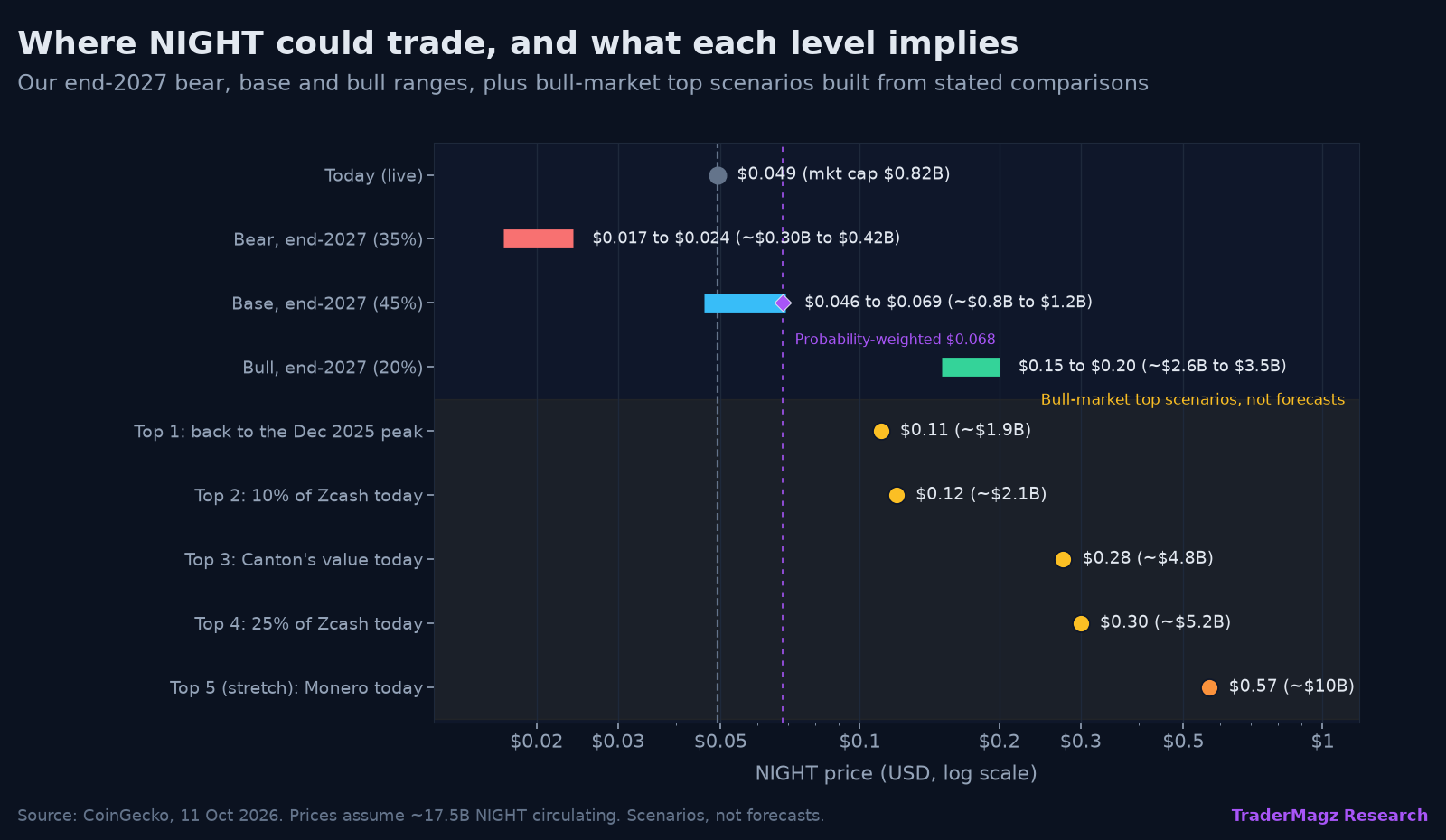
Two pairs of methods land close together, which is the useful part. $0.11 to $0.12 is the first top zone, about 2.3x from here, and only needs NIGHT to regain its launch valuation. $0.28 to $0.30 needs Midnight to be worth what Canton is today, with real regulated usage to justify it. $0.57 means a two-year-old chain with no fee revenue worth as much as Monero. We would not plan around it.
The price action
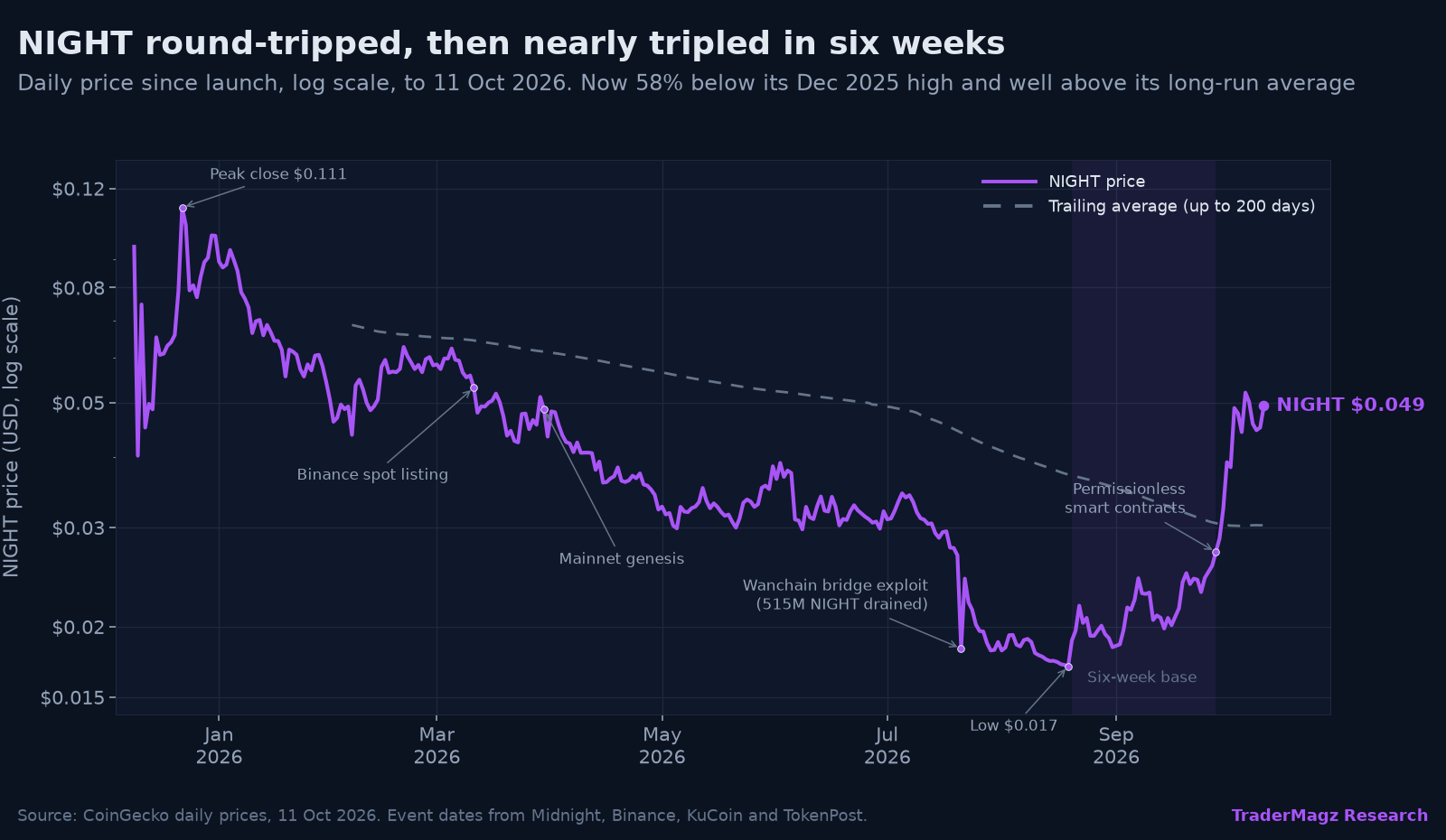
NIGHT peaked at $0.111 (daily close) on 22 December 2025, bled through the Binance listing and mainnet launch, crashed after the July bridge exploit and bottomed at $0.017 on 19 August. It then based at $0.018 to $0.025 until the permissionless switch and nearly doubled in the week after it. It now trades about 63% above its trailing average, near the $0.052 to $0.055 resistance that capped last week's high.
That is a strong trend change, and also a stretched one. OKCoinJapan lists NIGHT on 13 October, which often marks a short-term peak rather than a start. Bitcoin is $83K, about 15% above its 200-day average: supportive, but not a reason to chase a small token that just went vertical.
The risks, steelmanned
The best bear argument is that NIGHT is a narrative token with no cash flows, priced off one week of activity, with half its supply in the hands of insiders.
Concentration is the biggest risk. The Foundation and Midnight TGE Ltd hold 12.06B NIGHT, unlocked, at their discretion. Both say they intend to report material transfers, but that is a statement of intent, not an obligation. Any visible selling into this rally would hit a thin float.
Value capture is unproven. DUST is burned, nobody collects fees, and the demand drivers for NIGHT (apps holding it for capacity, SPOs earning it, DUST leasing) are designed but not live. If apps can lease DUST cheaply, they may never need much NIGHT.
Decentralisation is slipping. The network is run by approved operators, Mōhalu has missed its Q2 to Q3 window, and until SPOs produce blocks Midnight is closer to a consortium chain than a public one. Its operator roster is a selling point for institutions and a weakness for the crypto-native crowd that drives token prices.
The usage may not be real yet. A 92x jump in the first week after permissionless deployment is exactly what developer testing looks like.
Competition is strong and the category is mixed. Zcash owns private money, Canton owns institutions, and the two closest technical peers, Aztec and Aleo, have lost most of their value.
There is ecosystem friction. At TOKEN2049 this week, Charles Hoskinson publicly criticised the Cardano Foundation for leaving Midnight off the Cardano booth. Midnight's fortunes are tied to Cardano, and ADA is down 63% in a year.
And it is still crypto. A risk-off turn, a cooling of the privacy trade, or a Zcash correction would hit NIGHT far harder than its fundamentals.
What would make us buy, and what would make us walk away
We would start a position on a pullback, not at the breakout. Our accumulation zone is $0.032 to $0.039, the top of the October breakout and close to the trailing average. A daily close below $0.024, back inside the pre-breakout base, invalidates the swing view. Swing targets are $0.065, then $0.089 and the $0.11 high.
We would upgrade to a hold if:
- Daily transactions stay above about 10,000 through November once launch testing fades.
- v8 private tokens ship in Q4 and Mōhalu gets a firm date, with SPOs producing blocks.
- Foundation and TGE wallets stay quiet, which anyone can check against the bucket addresses published at midnight.gd.
We would walk away if the activity falls back toward a few hundred transactions a day, if the entity wallets distribute into strength, if Mōhalu slides into 2027 without a date, or if Bitcoin loses its 200-day average. The next checkpoints are the OKCoinJapan listing on 13 October, the end of the claim thaw in early December, and the v8 release.
Bottom line
Midnight is the most credible attempt yet to make privacy something regulated businesses can use, with a smart token design, institutional operators and a broad holder base. That is worth owning a small piece of. But the token earns nothing directly, the network is still permissioned, the usage is a week old and half the supply sits with insiders. At $0.049, after a near-tripling, the base case says the price is roughly fair. We would let it come back to us, size it like an option, and let the bull tail do the work. If privacy leads this cycle, $0.11 to $0.12 is a reasonable first target and $0.28 to $0.30 needs real regulated adoption to get there.
Sources: CoinGecko (NIGHT, ZEC, XMR, CC, ADA, AZTEC, ALEO, RAIL, BTC; 11 Oct 2026); Midnight Tokenomics and Incentives Whitepaper v1.81 (May 2026); Midnight FAQ and blog; CryptoSlate (federated operators); GNcrypto and CoinMarketCap (permissionless deployment); TokenPost, KuCoin and U.Today (transaction surge); KuCoin, Cryptonomist and Web3 Is Going Great (Wanchain exploit); Binance HODLer announcement; Crypto Briefing and The Crypto Basic (TOKEN2049); KuCoin and BIT (Zcash); DEV Community and Milk Road (privacy-chain comparisons).
This is general commentary, not personal financial advice. Crypto assets are volatile and you can lose your whole investment.